MCU Temp Experiment
I had two goals for this experiment, log the MCU temp every five minutes and see how long it would run on battery when going into deep sleep.
The MCU temperature is obviously not going to be the ambient temperature, but by putting it in deep sleep that should allow a lot of heat dissipation over the five minute sleep. This project came up with some interesting results that inspire future experiments.
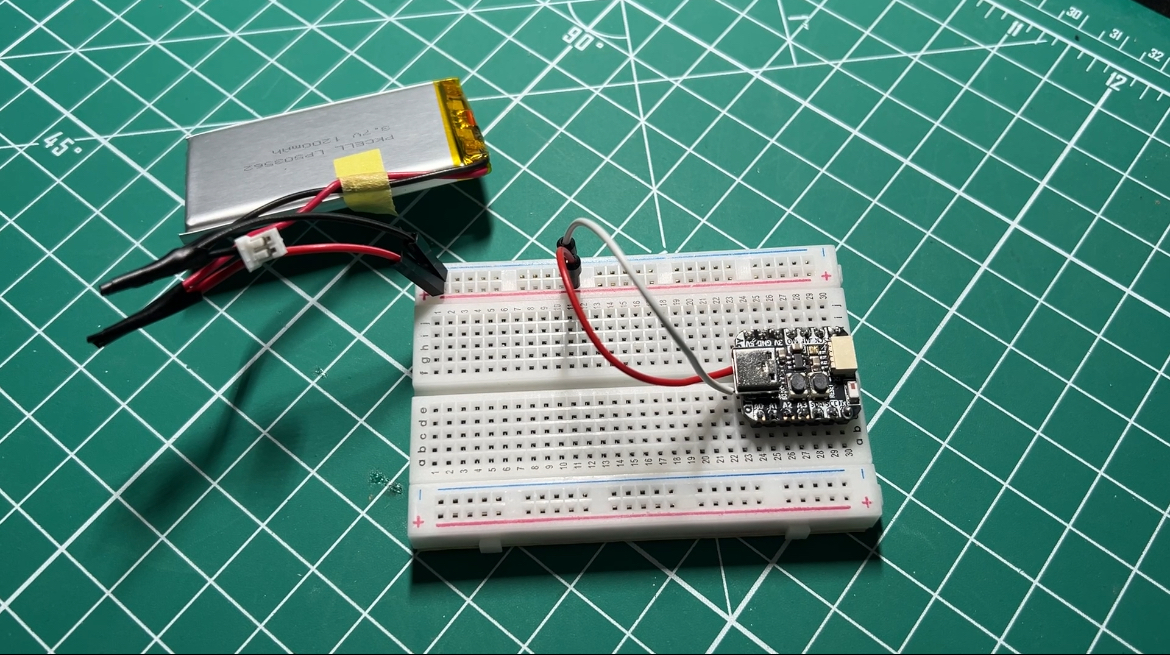
Hardware
- Small breadboard
- Adafruit QT Py ESP32-S3 with headers
- 1200mAh Lipo battery with cable spliced with cables that will plug into the breadboard
- USB C cable for connecting to laptop/desktop
Software
Unfortunately pelican isn't dealing with the code block correctly to put my code in here :-/
QT Py Write Mode
If you are doing this when powered by USB, you'll need to have a boot.py with code to allow you to press the boot button and get the QT Py into write mode for logging to the file.
Results
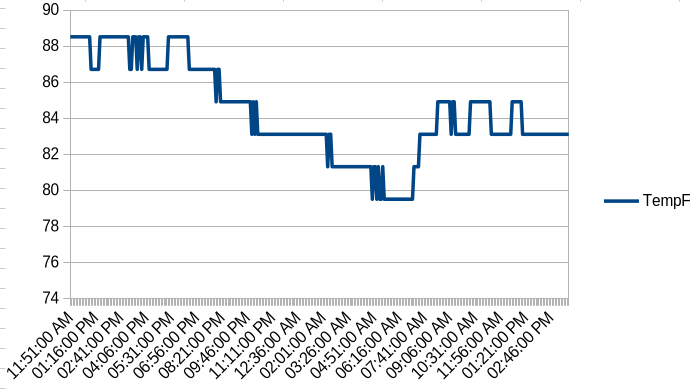
The logger successfully logged the timestamp and tempt to the file for 40 hours before the battery was exhausted. I was a bit surprised that it didn't last longer. In deep sleep it should only draw about 10uA and with a 1200mAh battery there are 1,200,000uA in it. It does have to power up, run the code, and flash the LED for one second. The sleep cycle is 299 seconds and the variance I was seeing in the timestamp is 0.1 second or so that must be the code running.
Looking at the graph of the output you can see that in the late evening the temperature starts dropping and doesn't climb until the morning. The temp in the house went from 68F down to 65F overnight and went back up at 0700, which lines up with the graph. What is interesting is that there is an eight degree swing in the log. There are also those almost two degree spikes every so often. I know the heat comes on in the room periodically to maintain temp, but it is odd that there are blocks of time that are warmer.
Next Steps
I will run this again with a separate, more precise temperature sensor. That should answer some questions. I'd like to get a USB power monitor so I can get some realtime info on power draw in various situations.